
Broadcast Solutions UK
Leading in the development, planning and realisation of complex systems and products for broadcast and media.
Broadcast Solutions plans, implements and realises projects in all broadcast and content related areas:
Broadcast Solutions offers innovative and sustainable solutions for the broadcast and media industry. We plan and implement projects and solutions that cover the entire value chain of the broadcast and media industry.
Our tailormade services portfolio, with a focus on consultancy and design, support customers in the realisation of their projects to improve efficiency, workflow and sustainability.
Broadcast Solutions (BS) UK Ltd.
Belvedere House, Suite 2.2
Basing View, Basingstoke
Hampshire, RG21 4HG
United Kingdom
sales(at)broadcast-solutions-ltd.co.uk
System integration
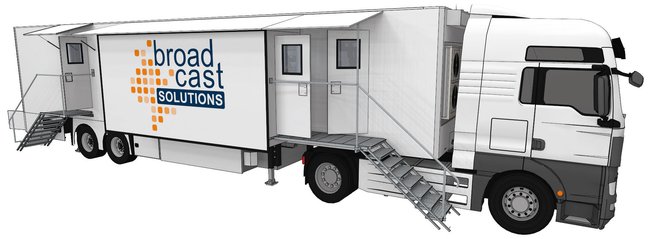
Broadcast Solutions is a global system integrator, with offices in Europe, Asia and the Middle East, and more than 200 employees worldwide. We plan and develop complex projects for broadcast and media environments, TV and radio, and are specialists in system integration for mobile production equipment (OB trucks, Satcom) and fixed installations (studios, playout centres, MCRs).
Broadcast Solutions offer the full lifecycle of services to support media companies, with service offerings being tailored to support the needs of the organisation. Broadcast Solutions look to build long term relations with their end-customers by providing complementary services to support the existing in-house capabilities of their customers. Whether this be through project conception, system design, project implementation, operator training or long term system maintenance.

hi human interface®
hi human interface® - the first intuitive control system for broadcasting and media infrastructures
With the changing technologies and workflows in the broadcast and media industry, configuration processes can take a lot of time and effort and, in the worst case, must be redefined each time a device changes in the system. hi from Broadcast Solutions makes the configuration process intelligent and simple, the tool automatically detects new devices and protects the user from configuration errors.
Upcoming Events
Your chance to meet us!
London Olympia | Stand C57
Connecting the media & broadcast industries
RAI Amsterdam, Netherlands
The world's most influential media, entertainment & technology show
Products
Broadcast Solutions UK distributes several innovative products from world-leading manufacturers on various levels. Our focus is on offering our customers the best tools available on the market. We act as a sales partner, reseller, and distributor. Contact us for more information on the following brands.
Manufacturers





CyanView
CyanView offer a unique set of control products that enable control and processing for third party system camera and mini cameras
The CyanView family of products enable cross-vendor control of cameras, lenses and Pan-Tilt-Zoom heads across wired or wireless & mobile networks for both on-prem or remote operation.
The system includes its own colour balancing processors for prosumer and mini-cameras or integration with third party processing devices (e.g. Lawo V_Pro8) for advanced video processing.
Broadcast Solutions (BS) UK Ltd.sales@broadcast-solutions-ltd.co.uk
+44 (0) 7791 380 210
Compact key-features
- Seamless integration with Dreamchip cameras
- In-house or remote connectivity
- Extensive third-party camera control (Panasonic, Hitachi, Sony, Dream chip to name a few)
- Power-over-Ethernet connectivity
Domo Tactical Communications
Domo Tactical Communications (DTC) are leaders in wireless technologies for high performance surveillance, communications, and broadcasting.
Systems are designed to ensure reliable communications in the most demanding of environments. DTCs professional, highly secure networks use wireless video and IP, cellular, covert Audio and Video and C2 systems to ensure optimal performance.
Broadcast Solutions (BS) UK Ltd.sales@broadcast-solutions-ltd.co.uk
+44 (0) 7791 380 210
Compact key-features
- Software definable transmitters for COFDM, Mesh and encoding applications
- Mixed profile devices to suit differing applications and camera systems
- High performance, reliable RF communications using military grade technologies
- HD and UHD systems with high quality HEVC encoding/
Dream Chip
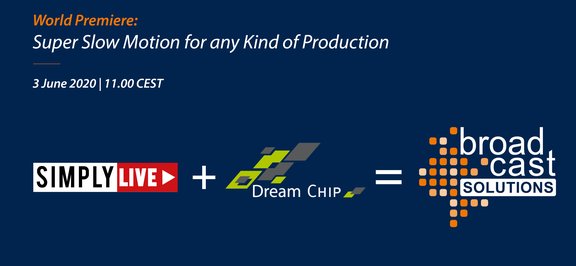
Dream Chip offers a complete array of high-quality miniature PoV cameras for Broadcast with unrivalled picture quality.
Perfect for supplementing main camera positions or for lower cost productions. The Atom one family of products are the smallest range of Broadcast quality cameras in the market with models supporting Full HD and UHD capture. Dream Chips latest HD camera (SSM-500) is a revolution in Super slow-motion production, with staggering results at an affordable price point.
Broadcast Solutions (BS) UK Ltd.sales@broadcast-solutions-ltd.co.uk
+44 (0) 7791 380 210
Compact key-features
- Broadcast quality miniature cameras
- Exception image performance
- Cameras from as little as 30x30x13mm
- Full HD, UHD, SDI, HDR (HLG, PQ) outputs
Konvison
Konvision are a leading manufacturer of professional and broadcast HD/4K monitors and displays for reference and confidence monitoring.
With panels ranging from 7” up to 65”, in a mix of resolutions, Konvision offer affordable high-quality monitoring for broadcast applications. Konvision provide solutions for field-based monitoring, fixed confidence monitoring, colour grading, reference monitoring and large scale video walls.
Broadcast Solutions (BS) UK Ltd.sales@broadcast-solutions-ltd.co.uk
+44 (0) 7791 380 210
Compact key-features
- Range of confidence, reference and grading monitors
- Integrated functionality such as waveform, vectorscope, PiP and audio metering
- SD, HD, 4K and 8K panels with comprehensive connectivity
- Large video wall monitors for studio sets and multi-split monitoring
LaON
LaON technologies, offers two-way communications for low latency applications.
The hybrid wired and wireless intercom system is ideally suited to fixed and mobile facilities. It uses 5GHz UNII band frequencies for highly performant, secure wireless audio transport.
Broadcast Solutions (BS) UK Ltd.sales@broadcast-solutions-ltd.co.uk
+44 (0) 7791 380 210
Compact key-features
- Seamless, Reliable and east to extend
- Secured communications through AES 256bit
- Fully scalable and flexible multi-channel system
- Matrix free connectivity
Mobile Viewpoint
Mobile Viewpoint (MVP) provide innovative technologies for mobile and AI enabled productions. With a range of devices bringing new use cases and capabilities.
Mobile viewpoints bonded 3G/4G streaming technology has been used by broadcasters worldwide to capture high-quality ENG contributions from the field. 5G technologies push MVPs capabilities further with higher possible bandwidths and features.
MVPs AI enabled solutions, bring automation for low cost, highly efficient production with distribution cross platforms.
Broadcast Solutions (BS) UK Ltd.sales@broadcast-solutions-ltd.co.uk
+44 (0) 7791 380 210
Compact key-features
- Mobile and fixed 3G/4G enabled encoding/ decoding
- Distribution to linear and OTT platforms
- AI enabled devices for automated studio and sports production
- Web based stream management and control
Newsbridge
NewsbridgeTM is a cloud-based ‘Story production platform’, which utilises multi-modal AI to cross-analyse multiple data sources to create rich metadata for broadcasters media.
The platform can be delivered as a standalone solution for full cloud-based production or as a value-add on to an existing MAM system to improve the quality of indexed media.
Newsbridge uses Google AI technologies and Wikidata for extensive data sets and processing capabilities. Operator feedback and training improves the system accuracy and confidence.
Broadcast Solutions (BS) UK Ltd.sales@broadcast-solutions-ltd.co.uk
+44 (0) 7791 380 210
Compact key-features
- No need for on-prem hardware and be scaled up and down as needed
- Access from anywhere at anytime
- Updates instantly available no update/ migration plans needed
- Access to extensive and ever-growing data sets through Wikidata
- Direct, remote contributions from IP streaming devices
Nxtedition
Nxtedition is the next paradigm in live media production, consolidating all areas of production into a single user-interface, removing the need for multivendor solutions which introduce inefficiencies and manual workflows.
It is a content centric web-based platform using virtualised application (prompters, newsroom control systems, automation, MAM, transcode, etc) to support production workflows. At the heart of the system is a powerful metadata and search toolset, the latter of which provides ‘Google’ style, fuzzy search functionality across the system to deliver highly complex, concatenated search results.
Broadcast Solutions (BS) UK Ltd.sales@broadcast-solutions-ltd.co.uk
+44 (0) 7791 380 210
Compact key-features
- Integral planning, scripting and rundown tools
- Harvesting of data from social media, wire feeds and RSS feeds.
- Highly intelligent fuzzy search logic and AI Automated indexing
- Video management, clipping and editing toolsets for fast and simple story creation
- Integrated graphics, subtitling and studio automation tools
- Effective remote operation
Q5X
Q5x wireless audio wearable transmitters are designed to be both discrete and comfortable in challenging conditions.
Their wireless technology has been adapted to suit performers, athletes and coaches who are constantly on the move in challenging and adverse conditions. Transmitters are therefore designed to be small, comfortable and wearable. Applications include, Sports audio, Venue sound and Location sound.
Broadcast Solutions (BS) UK Ltd.sales@broadcast-solutions-ltd.co.uk
+44 (0) 7791 380 210
Compact key-features
- Exceptionally compact & low profile
- Splash proof or waterproof design
- Flexible and comfortable units
- Tough ruggedized design for sports use
Silvus
Silvus Technologies are highly reliable and secure wireless radio communications system targeted at the defence and emergency services but also for broadcast where reliable communication is mandatory.
The Silvus system uses technologies developed over 15 years from the communications research community to provides reliable, high bandwidth, meshed video and data communications in the world’s most challenging conditions. Techniques such as COFDM, MIMO, MANET are all enablers to provide unparalleled performance and flexibility.
Broadcast Solutions (BS) UK Ltd.sales@broadcast-solutions-ltd.co.uk
+44 (0) 7791 380 210
Compact key-features
- Self-healing and self-forming networks
- Link Adaption for optimised connectivity
- Simple scale out to address dead spots
- Optimised signal routing for improved performance
Simplylive
SimplyLive provide creative tools based on a software definable architecture for live production.
Simplylive is a software enabled platform for live production. Application layers can be licensed to run on the core hardware platform, with capabilities for all-in-one production (Create), Slo-motion record and playback (replay), video assisted referee (Review) and master recording (record).
The Simplylive platform offers multiformat connections (SDI, NDI, IP) and is migratable to the cloud. Multi-client users can connect to virtual servers with shared data across the network.
Broadcast Solutions (BS) UK Ltd.sales@broadcast-solutions-ltd.co.uk
+44 (0) 7791 380 210
Compact key-features
- Choice of hardware platform to suit production demands
- Flexible, multiformat connectivity
- Software based application layer enabling adjustable functionality.
- Shared multi-user on-prem and remote productions
Zero Density
Development of Virtual Studio technologies dedicated to broadcasting, live events and Esports industries. Zero Density is offering the next level of production with real-time visual effects.
Zero Density uses an Unreal-Engine from Epic games to create photo-realistic visual effects and includes an Integrated advanced Image-based keyer running on GPUs for internal video compositing.
Using a system like Zero Density enables optimisation of your studio space, giving greater flexibility from a single system asset.
Broadcast Solutions (BS) UK Ltd.sales@broadcast-solutions-ltd.co.uk
+44 (0) 7791 380 210
Compact key-features
- Mixed augmented and virtual reality
- Remote teleportation of talent, 3D masking and hybrid productions
- HD, UHD and HDR Support
- Extended integration with third party systems like NRCS and Automation systems.
Technology
4K/ Ultra-HD primarily delivers a huge improvement to the amount of detail and clarity within an image. The resolution of Ultra-HD is four times that of a 1080p HD signal - 8 million pixels compared to 2 million
The huge level of data delivered by Ultra-HD (12Gbps) requires equipment that is able to process these signals. The availability of such technology is now at a point at which is it becoming more viable, both financially and functionally. Broadcast Solutions has seen a continual shift towards this improved format and is in a unique position to be able to provide the skilled resource to deliver these Ultra-HD systems.
Key benefits of introducing Ultra-HD technology include:
- Ultra-HD delivers sharp, crisp, high resolution images with 4x the quality of HD;
- It is an investment in a future proof technology with a long life span;
- It is an opportunity to be leaders in the market and technical innovators;
- It can open up additional production business which otherwise may not be targeted.
Broadcast Solutions have delivered a large number of UHD systems using both IP and baseband infrastructures to transport and are able to advise on the optimal solution which brings you both commercial and technical gains.
High Dynamic range (HDR) is one of the key improvements of both the HD and Ultra-HD format and provides a significant improvement to the end-user.
HDR is the ability to capture, process & display a much higher range of brightness than is currently possible. An image reproduced with HDR has much better detail within the shadows and highlights without either being lost in darkness or saturated (respectively).
The combination of High Dynamic Range and Wider Colour Gamut (WCG) provides huge increase in colour volume and as such an improved image reproduction to the end-user. Transfer functions such as HLG and PQ enable this large dynamic range to be compressed into a 10 bit sample depth enabling better consumer experience already supported by much of the existing infrastructure.
Broadcast Solutions technologies for UHD include support for increased colour volumes and this is now being extended to our HD solutions to enable better percieved resolutions with minimal impact to existing infrastructures.
IP connectivity is the new wave in Broadcast connectivity with ST2110 being largely regarded as the standard that all broadcasters and manufacturers will adopt. Whilst IP projects are still highly complex and subject to ‘incompatibilities’, the standardisation of ST2110 has provided a means for the industry to move forward and broadcasters are beginning to embrace this new technology.
Broadcast Solutions is at the forefront of this technology having previously delivered IP systems using both ST2022-6 and ST2110 to support HD and UHD production. We work closely with IP product suppliers and network switch manufacturers to ensure systems are interoperable and can dovetail into today’s legacy SDI based environments. Importantly systems are designed with the future in mind and products are selected to maximise the system reuse and simplify system expansion.
Whilst ST2110 represents the pinnacle of IP technologies for uncompressed live production, other technologies such as NDI and the eventual adoption of IPMX into the ProAV market have their place within the broadcast professional world and Broadcast Solutions is able to offer advice and expertise into these technologies also.
Broadcasters recognise that the move to IP is a game-changer and one which requires a ‘reskilling’ of their maintenance/ administration staff. Broadcast Solutions are able to support customers in gaining the appropriate skillset by facilitating training courses and providing 1st line support to customers during the initial bedding in phase for a project.
Up until recently, there have been many differing Audio over IP technologies adopted by broadcasters for different purposes, each with their benefits. These include Dante, Ravenna, Livewire, WheatNet-IP & Q-LAN. The principles of these technologies are to use the 7-layer Open Systems Interconnection (OSI) network model and standard networking protocols to transport audio data between enabling audio to propagate standard LAN and WAN network connections.
The advantages of the network-based AoIP systems provided include:
- Higher channel counts
- Flexible signal splitting & routing
- A consolidate synchronisation architecture
This adoption of different technologies has led to challenges when exchanging signals, with media companies often relying on traditional MADI or Analog/ AES/EBU connections to exchange audio. The Audio Engineering Society recognised this and defined the AES67 standard as a minimum set of conditions, which used existing protocols where possible but which, when adopted by the differing AoIP technologies, would allow for the exchange of audio signals. In effect, by complying with the AES67 standard, AoIP technologies guarantee they are interoperable.
Importantly, AES67 was adopted as the core audio transport mechanism for ST2110-30 and therefore is used within IP systems as the mechanism to carry audio data. These standards are adopted within Broadcast Solutions IP based systems (ST2110) and our engineering team can advise on the optimal design to allow AoIP enabled products to communicate.
Cellular bonding of 3G/4G and now 5G connections to provide high data rates for video transfer allows for production from anywhere at any time. These systems use highly effficient H.264, H.265 or HEVC codecs to transfer HD and UHD signals over mobile phone connections.
The mobile connectivity provides speed-to-air for direct connection into broadcast infrastructure or social media platforms which were previously inaccessible by large satellite uplink vehicles. This means reporters are able to get close to the action with minimal equipment and support crew.
Broadcast Solutions partner with Mobile viewpoint for the provision of encoding/ decoding products which use cellular bonding.
The use of Virtual reality and Augmented Reality has become more prevalent recently as the graphics processing engines have become more powerful, cost effective and the graphics more sophisticated. The latter Augmented reality is being used extensively within large scale productions (i.e. FIFA World Cup, Elections etc.) to enhance the user experience and provide more engaging ways to display important data and statistics. Virtual reality has been a popular technology for broadcasters for many years providing simple ways to change the look and feel of a program with minimal cost.
Broadcast Solutions has close relations with graphics suppliers such as Zero Density who are able to create the latest hyper-realistic VR and AR graphics by using Reality Engine® as the real-time compositing solution.
The live production environment is one which is traditionally requires lots of skilled resources to operate. Studio automation systems are becoming increasingly popular and sophisticated and offer an opportunity for broadcasters to free up their operational staff to focus on being more creative. Furthermore, the automation systems provide a way for broadcasters to bring structure and standardisation across their programming by applying a brand ‘look-and-feel’ through production templates.
Broadcast Solutions are seeing a need for these automations systems to be used in a more self-op mode, with presenters now having the freedom to control their own productions whether this be from the studio floor or in the field. This means deploying automation toolsets to mobile devices such as laptops and mobile phones.
Automation and control systems such as Broadcast Solutions Human interface, Mosart, Ross Overdrive and others are bringing efficiencies into production workflows by allowing for more creative productions with fewer staff.
Virtualisation is nothing new to the broadcast industry and software suppliers continue to improve support for virtualisation technologies such as VMWare, Hyper-V, with an end goal to be platform agnostic.
Broadcast Solutions looks to design solutions that are as advanced as possible and can make use of such technologies as Hyperconvergence and software defined storage to optimise the platform usage and enable customers to easily scale up/down with minimal disruption.
This includes cloud centric solutions for processing, production and playout using cloud technologies such as Microsoft Azure and Amazon AWS. Installations of systems within the cloud offer customers differing revenue models with fast scale out capabilites, access from anywhere and no on-prem equipment.
Cloud really becomes a benefit to broadcasters when deployed as a hybrid environment with a mix both on-prem and off-prem compute, relying on the cloud processing to provide ‘scale-up/out’ processing as the production dictates. A cloud platform, mixed with the predictive data usage that AI/Machine offers makes for a very powerful and intuitive system.
Broadcast Solutions has close links to major IT suppliers and service providers who can provide platforms to meet both off- and on-prem models and are able to tie broadcast upgrade projects into customers’ wider office IT upgrades/ migrations.
Artificial Intelligence (AI) and Machine Learning (ML) is an area that is developing extremely rapidly and is expected to bring efficiencies into the broadcast industry to provide more effective ways to analyse and manipulate data. Many areas will be strongly impacted, such as:
- Process automation
- Network optimisation
- Predictive maintenance
- Audience insights
- Recommendation, search and discovery of content
- Automated content annotation
- Content creation.
Broadcast Solutions sees a number of start-up companies and existing software providers developing products or ‘add-ons’ that utilize AI or ML to help improve the efficiency and capability of broadcast systems.
Importantly suppliers recognise that these systems need to facilitate and enhance existing workflows rather than totally replace them and as such AI solutions are integrated into existing production platforms to offer improved indexing and media manipulation.
The ability to ‘follow the story’ and ‘produce from anywhere’ is the current and future demands for broadcasters facilitated by the improved availability of high-speed networks and the move of production into the cloud.
Whilst OBs are still prevalent, the demand for remote production increases and will eventually replace the need for large onsite facilities. Technologies using low latency, visually lossless codecs enable content to be transferred over the internet or leased lines rather than expensive satellite links.
Broadcast Solutions has had first hand experience in deploying these remote produciton solutions with the Finnish Ice Hockey league being an example of remote production for one of fourteen Ice Hockey clubs across the country.


Team & Office
Broadcast Solutions UK

Managing Director

Sales Manager UK
Kevin Fitzgerald
k.fitzgerald(at)broadcast-solutions-ltd.co.uk

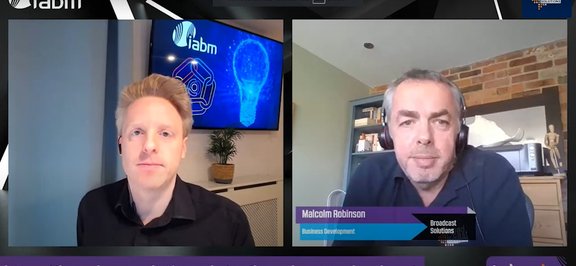
Business Development
Malcolm Robinson
m.robinson(at)broadcast-solutions-ltd.co.uk
